
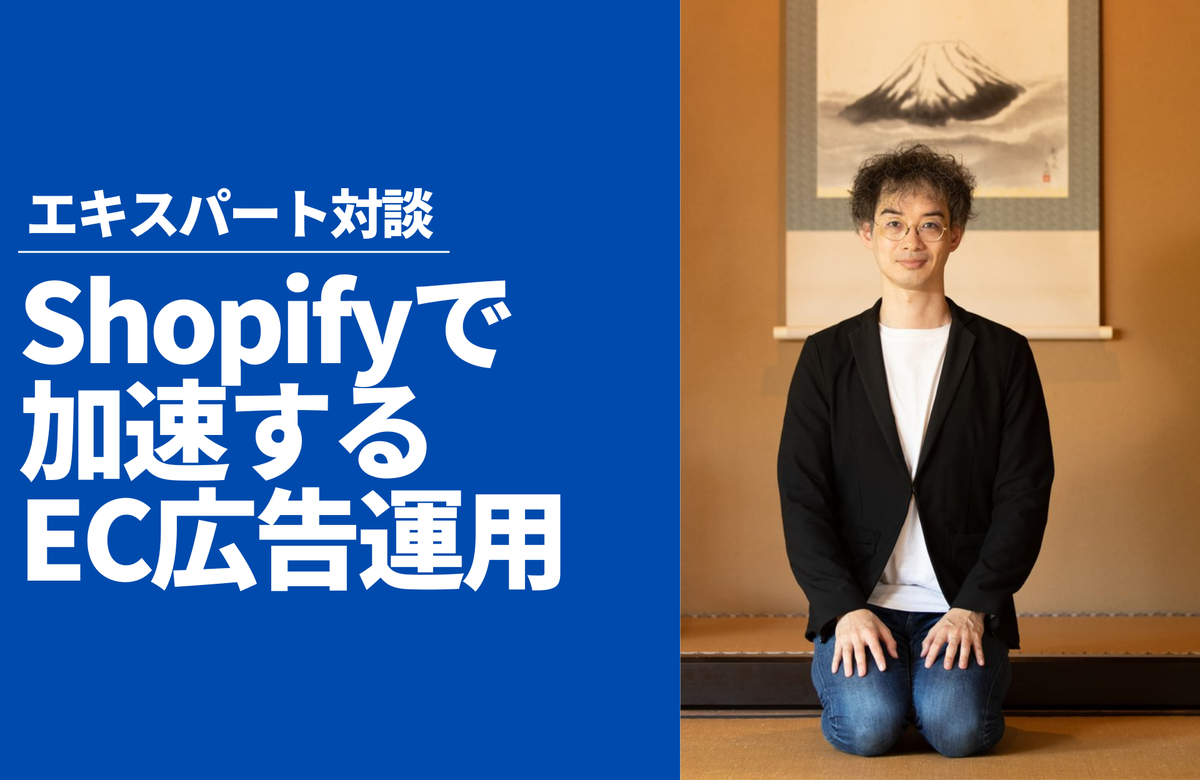
Accelerating E-Commerce Ad Operations with Shopify: Data Integration and Creative Strategy in the AI Era — A Conversation Between Hiroki Tanaka, CEO of Yuwai Inc., and StoreHero CEO Kurose
Introduction
Our featured guest today is Mr. Tanaka, a veteran who has been at the forefront of web advertising operations for many years. He began his career as a broadcast engineer at NHK before transitioning into digital marketing. After gaining experience at an Airep-affiliated venture and Anagram Inc., he became independent last year. He is now active across a wide range of areas, including in-house ad operations support for business owners and training for junior staff at advertising agencies.
In this conversation, we spoke extensively about the unique characteristics of EC advertising using Shopify, platform selection centered on Google and Meta (Facebook/Instagram) ads, as well as data utilization, creative strategy, and future trends.

Mr. Tanaka's Background
Kurose: Since some readers may be encountering Mr. Tanaka for the first time, could you briefly walk us through your career so far?
Tanaka:
I started my career as a broadcast engineer at NHK. After that, around 2009, I moved into ad operations at an advertising agency, and in 2012 I joined Anagram as its first employee. I spent about eleven and a half years there before going independent last September. Currently, I support business owners with in-house ad management and provide training and support to junior staff at advertising agencies.
Distinctive Features of Ad Operations on Shopify
Kurose: When it comes to leveraging Shopify, what specific advantages stand out most on the advertising operations side?
Tanaka:
Because Shopify originated overseas, it integrates extremely smoothly with international advertising platforms such as Google Merchant Center, Meta's catalog, YouTube Shopping, and Pinterest. Product data and inventory are reflected with a single click, enabling marketers to set things up quickly on their own.
In today's programmatic advertising systems, feeding first-party data into machine learning has become the dominant trend. For example, Google supports customer audience lists for Customer Match, and Shopify makes syncing and updating those lists effortless and automatic. This infrastructure allows advertisers to ride the latest wave of programmatic advertising smoothly and achieve efficient ad operations.
Kurose: On the other hand, what points should businesses be careful about when implementing and operating Shopify?
Tanaka:
Shopify is highly customizable and supports a wide variety of apps, but this can sometimes result in discrepancies between the pricing and inventory information displayed on the site and the information sent to the ad platform. For example, if discounts or shipping calculations are managed independently by an app, the feed data on the ad side may diverge from what is shown on the site, potentially leading to disapprovals in Merchant Center. Inconsistencies in pricing in particular require close attention.
Ad Platform Selection and Operational Thinking
Kurose: In EC advertising operations, is there a good way to differentiate the use of platforms like Google Ads and Meta Ads depending on the products being sold and the scale of monthly revenue?
Tanaka:
My impression is that it varies more by business model than by product type. Comprehensive EC stores with a large number of SKUs (stock-keeping units, i.e., product variants) tend to make full use of Google Shopping Ads, Performance Max (P-Max), and Meta catalog ads. Conversely, for single-product subscription businesses where product understanding is essential, visual- and text-based appeals on Meta are often more effective. It is also easy to frame it as: Meta for impulse purchases, Google for intent-driven purchases.
Kurose: What about other platforms, such as Yahoo! or TikTok?
Tanaka:
Yahoo! is used as well, but tends to be lower priority. TikTok can have unstable measurement accuracy in some cases, so Meta remains more reliable at this point. On Google, P-Max has become the mainstream approach, with more campaigns being built around shopping feeds.
Kurose: From a creative standpoint, what differences and characteristics do you see between Google and Meta?
Tanaka:
Google's P-Max automatically optimizes across search and shopping, while Meta's Advantage+ Shopping Campaigns work best by feeding in a large volume of creative assets — videos, collections, catalogs — and letting machine learning take over. In terms of creative formats, Meta pairs well with video content and the Instagram placement, while Google's primary strength lies in shopping. The formats that work best on each platform are quite clearly differentiated.
Tips and Pitfalls in Data Integration
Kurose: While data integration is straightforward, are there any pitfalls or points to watch out for during implementation and operation?
Tanaka:
Product names used in ads must comply with platform policies and should be structured so that the information most relevant to potential buyers appears at the front. While it is tempting to include promotional copy like "free shipping" in product names displayed on the web, this can violate ad review policies, so it is important to manage feeds separately — one version for web display and another optimized for advertising.
Kurose: In what ways is customer data actually being reflected in business strategy and initiatives in practice?
Tanaka:
Rather than uploading customer lists as-is, it is important to clean the data first — for example, by segmenting it by product category. When dealing with a broad product lineup, feeding in the entire customer list at once can confuse the machine learning algorithm. Organizing customer attributes by category and building precise lookalike audiences from that foundation directly impacts results.
Kurose: Regarding Conversions API and enhanced conversions, what advantages and challenges do these offer from a measurement perspective?
Tanaka:
Implementing these improves attribution accuracy and can be expected to capture an additional 1–5% of conversions. The more learning data is accumulated, the more accurate the automated optimization becomes. However, handling personal information requires extreme care, and legal measures such as updating privacy policies and obtaining user consent are mandatory.
Creative Strategy and Landing Page Optimization
Kurose: When considering approaches beyond catalog ads, what are the most important areas to focus on in terms of creative strategy?
Tanaka:
On Meta, video formats on the Instagram placement tend to be particularly strong. Rather than elaborate productions, casual videos shot by staff on a smartphone with some text overlay surprisingly often outperform more polished assets. Ultimately, the key is content that allows users to intuitively understand the product's features. It is also worth repurposing organic posts that have performed well as paid ads.
Kurose: When rolling out creative, from what specific perspectives is consistency with the LP (landing page) ensured?
Tanaka:
If a product being promoted in an ad is left showing as sold out on the LP, the user experience deteriorates. Ad operators frequently check inventory and price consistency and make improvement suggestions. In practice, ads and LPs influence each other significantly.
Advanced Operations: Inventory, LTV, and Upsell Strategy
Kurose: Taking into account inventory management, LTV (Customer Lifetime Value), and upselling techniques, what kinds of strategic initiatives might go one step further?
Tanaka:
To be honest, improving inventory management and LTV is not something advertising operations alone can solve. Improving operations and product strategy is what ultimately raises the efficiency of advertising investment. When key products go out of stock, ad performance drops too, and upselling and cross-selling also matter. Advertising is a "tool for driving distribution" — it is maximized when it works in concert with product development, inventory planning, and site design.
Future Outlook: The Era of AI Utilization and Creative Innovation
Kurose: What trends do you foresee for the industry as a whole going forward, and what is your outlook for the future?
Tanaka:
AI will continue to evolve, and I believe the use of generative AI in creative production will become especially important. It is still difficult to produce a fully finished ad banner or video using only generative AI, but the process of using AI to output a rough draft of the concept in your head and then aligning it with a designer has already become dramatically more efficient. In the end, crafting instructions (prompts) and developing ideas still requires human ability to articulate ideas verbally. Operators and marketers who can effectively co-create with AI will become increasingly valuable going forward.
Summary
Operations centered on Shopify can make the most of data integration and machine learning, but they also require foundational work such as solid inventory and pricing operations and careful curation of customer data. Furthermore, creative improvement and data utilization know-how powered by AI are set to become new weapons in advertising operations going forward.
What emerges from Mr. Tanaka's experience is the perspective that advertising operations are not merely about "placing ads and optimizing" — they are a comprehensive business growth strategy encompassing inventory, customers, and product strategy. And what accelerates that growth is Shopify's flexible integration capabilities and the creative potential of the AI era.