
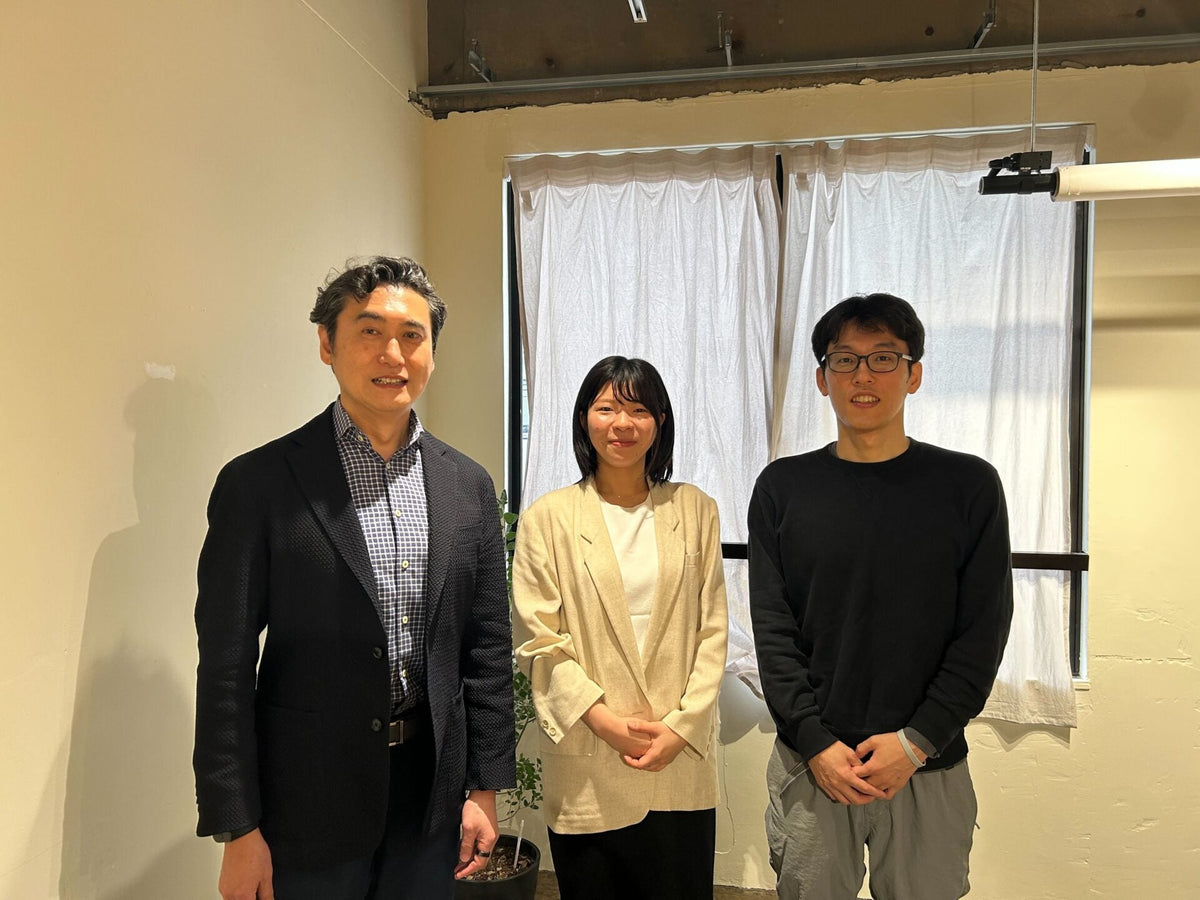
From Crowdfunding to a Continuously Selling EC Store. How Kibidango Store Delivers Niche Products to the Market
Kibidango has been bringing unique domestic and international products to the Japanese market through its crowdfunding platform, Kibidango, since its founding in 2013. Having created numerous projects worth hundreds of millions of yen, the company launched its own EC store, Kibidango Store, on Shopify in 2020, and has been working to expand its e-commerce business by continuously selling products that proved successful through crowdfunding.
"Just because something sold well on crowdfunding doesn't mean it will sell on EC" — we spoke with founder Matsuzaki and EC Division Manager Hirota about how they overcame that challenge, and about their journey of growth with StoreHero.
From Banker to Rakuten, and Then Into the World of Crowdfunding
—— First, could you tell us about your business?
Matsuzaki: I originally worked as a banker for about eight years, then joined Rakuten when the company still had fewer than 100 employees, and stayed there for 11 years. I was involved in M&A and corporate planning, working to build out the ecosystem around Rakuten Ichiba. I was drawn to the idea of helping startups and small companies grow, but as Rakuten became larger, I started feeling like there was less I could contribute. So I left in 2011 and went freelance.
When I was feeling the limits of what one person could do alone, I discovered Kickstarter and became a huge fan. The concept of connecting creators with people who support them really moved me, and I thought I wanted to bring this to Japan. In 2012, I went directly to meet the founders of Kickstarter.
I proposed expanding to Japan and a model that combined crowdfunding with EC sales after projects ended, but at the time they said international expansion wasn't a priority and turned me down. However, the Kickstarter founders made me realize I could just do it myself, so I gathered a team, spent a year preparing, and launched Kibidango in 2013.
Our business has three main pillars. First, crowdfunding. Second, continuing to sell on EC products that succeeded through crowdfunding. And third, something that has been growing recently: import sales agency and consulting, where we find interesting products from overseas manufacturers and introduce them to Japan.
We launched the EC business, Kibidango Store, in 2020 — seven years after starting crowdfunding in 2013. The trigger was manufacturers asking us to keep selling their products after their projects ended.

Hirota: I joined Kibidango in 2021. I started in the production department of the crowdfunding division, creating product pages for overseas projects, but developed an interest in long-term business growth and transferred to the EC division. Now, as EC Division Manager, I handle all aspects of direction and execution related to EC.
"All-or-Nothing" and 79 Million Yen. What Makes a Kibidango Project
—— What distinguishes Kibidango from other crowdfunding platforms?
Matsuzaki: We are committed to the all-or-nothing model, where a project only succeeds if it reaches its funding goal. Some platforms let you set a low goal to guarantee success, but we don't take that easy way out. If a project owner is genuinely challenging themselves, we support them with everything we have. I think that stance has become the defining character of Kibidango.
A great example is InstaChord, a project for a revolutionary new musical instrument that lets you play chords by simply pressing buttons. Other crowdfunding platforms had rejected it because they thought a 50-million-yen goal was unrealistic. But we saw the developer's passion, took it on, and gave it everything — and the project ended up raising 79 million yen, a tremendous success.
Other examples include ViXion01, a new type of eyewear that raised 425 million yen, and #X68000 Z, a miniature retro PC revival from the 1980s, which raised 350 million yen.

—— What factors drive such large amounts of funding?
Matsuzaki: It comes down to whether there are people out there who get excited about the project or product itself. With the retro PC example, people who had longed for that computer back in the day started buzzing about it on social media, and the enthusiasm spread rapidly. When passionate people voluntarily share and promote a project, that becomes one of the most powerful drivers of crowdfunding success.
Another key factor, when launching overseas projects in Japan, is not simply translating the English content, but recreating the creative work to fit the Japanese context.
For the DraftTop project — a can opener that removes the entire top of a beer can — we didn't use the American visuals as-is. Instead, we repositioned it around how it enhances the aroma of craft beer, tailored for the Japanese market. The result was raising approximately 56 million yen. Identifying what resonates with Japanese customers and redefining the value proposition is one of our core strengths.


Choosing Shopify for Scalability and Speed
—— What led you to adopt Shopify?
Matsuzaki: We started using Shopify for Kibidango Store in September 2020. At the time, launching an EC shop as quickly as possible was the top strategic priority. We considered integrating EC functionality directly into our own crowdfunding platform, but that would inevitably take time to customize and limit what we could do. We chose Shopify for its high scalability, fast launch capability, and branding freedom.

—— Are there challenges in selling EC products that succeeded in crowdfunding?
Hirota: Just because something sold well in crowdfunding doesn't necessarily mean it will sell on EC. Crowdfunding customers tend to be highly curious about new things and want to support products that haven't yet entered the market. EC customers, on the other hand, generally seek reassurance. They have the same expectations as shopping at a regular store, so post-purchase support becomes even more important.
There are also differences in ad creative. In crowdfunding, messaging that emphasizes a new experience resonates well, but in EC, approaches that communicate reassurance through numbers — such as "back in stock" or "X units sold" — delivered better results.
Also, EC requires holding inventory, so we can't buy large quantities from the start. We proceed carefully: starting small and placing additional orders as sales grow.
Partnering with StoreHero to Break Through Multiple Barriers
—— What challenges were you facing before reaching out to StoreHero?
Hirota: The biggest issue was that our Meta and Google ad measurement wasn't properly integrated with Shopify. Even though we were running ads, we couldn't accurately understand which ads were contributing to sales, and we were stuck — unable to improve because we couldn't identify the root cause. Inventory management and internal documentation weren't in order either, and our theme was on an old version, so even when we wanted to implement new initiatives, the foundation simply wasn't there.
—— Where did you start first?
Hirota: StoreHero first properly reconfigured our ad measurement integration. That finally allowed us to see ad performance accurately and make informed decisions about where to invest. At the same time, they helped us migrate to a new theme, which significantly improved site speed and design flexibility.
Having that foundation in place is what made it possible to pursue CRM and affiliate initiatives afterward. If you try to launch initiatives without proper measurement, you can't evaluate their effectiveness. And if your theme is outdated, implementing the initiatives in the first place becomes difficult. Getting the foundation right first was absolutely the correct order of operations.

—— After the foundation was in place, which initiatives delivered the most notable results?
Hirota: The initiative where I've felt the most impact is CRM, specifically email newsletter distribution. Previously, we were sending roughly once a month and honestly not putting much effort into it. As we worked with StoreHero and increased our sending frequency — for example, sending three times a week in December — we saw sales clearly move in tandem. It was a real eye-opener to see just how effective email newsletters could be.
One thing we focused on was presenting the same product from multiple angles. When you introduce a single product through different lenses — how to use it, its design, as a gift option — people find themselves wanting to click again even for a product they've already seen. Rather than repeating the same message, we always try to bring a fresh perspective. Our products tend to be niche, so with just one angle we might not reach everyone. By shining a light from different directions, we can reach customer segments that a single approach would miss. This multi-angle strategy emerged through trial and error working alongside StoreHero.

Partnering with Affiliates and Creators to Build New Awareness
—— You've also been working on affiliate partnerships.
Hirota: Yes, this has been another major initiative. Many of our products are niche and high-priced, which made it difficult to fully convey their appeal through advertising alone. StoreHero suggested leveraging affiliates, and we started collaborating with affiliates who provide in-depth product coverage.
When a product is introduced through a well-written article, it gives customers the confidence to purchase. The more niche the product, the more a third party's firsthand experience builds trust. Ads inevitably come from the seller's perspective, but affiliate articles are written from the user's perspective, making it easier for customers to imagine the actual experience. Especially for high-ticket items, we've really felt that sense of reassurance helps push people toward a purchase.

—— You're also working on leveraging AI.
Hirota: Yes, we've started initiatives to enrich our content using AI. The tricky part is that even if a product is interesting, if you don't communicate that effectively to the AI, you end up with generic copy.
—— Making AI smarter requires the process of putting into words — through human sensibility — what isn't working and why. If AI-generated content feels off to you, articulating specifically where and how it falls short and feeding that back to the AI will improve its output. The ability to verbalize that kind of craftsman-level knowledge is what will define competitive advantage in the age of AI. Let's work on that together.
Taking Crowdfunding to the World
—— Finally, could you share your vision for the future?
Hirota: For Kibidango Store, I want to establish a solid annual plan and be able to work backward from that plan. Kibidango Store carries products across a wide range of categories, so I want to clarify which products to focus on and how to grow our flagship products. Right now we tend to be reactive to whatever product is in front of us, so the next step is setting an annual budget, planning ad spend allocation and organic strategy in a structured way, and building the operational capacity to hit monthly targets working backward from there.
Matsuzaki: Until now, our focus has mainly been bringing products from overseas to Japan, but going forward I'd like to take on the challenge of introducing Japanese-originated projects to the world.
Kibidango has partners in countries including Taiwan and the United States, and I want to leverage that network to expand EC into overseas markets. Among the manufacturers we've supported in Japan, there are many products with demand abroad. I hope we can become a bridge that brings Japanese craftsmanship to the world.