
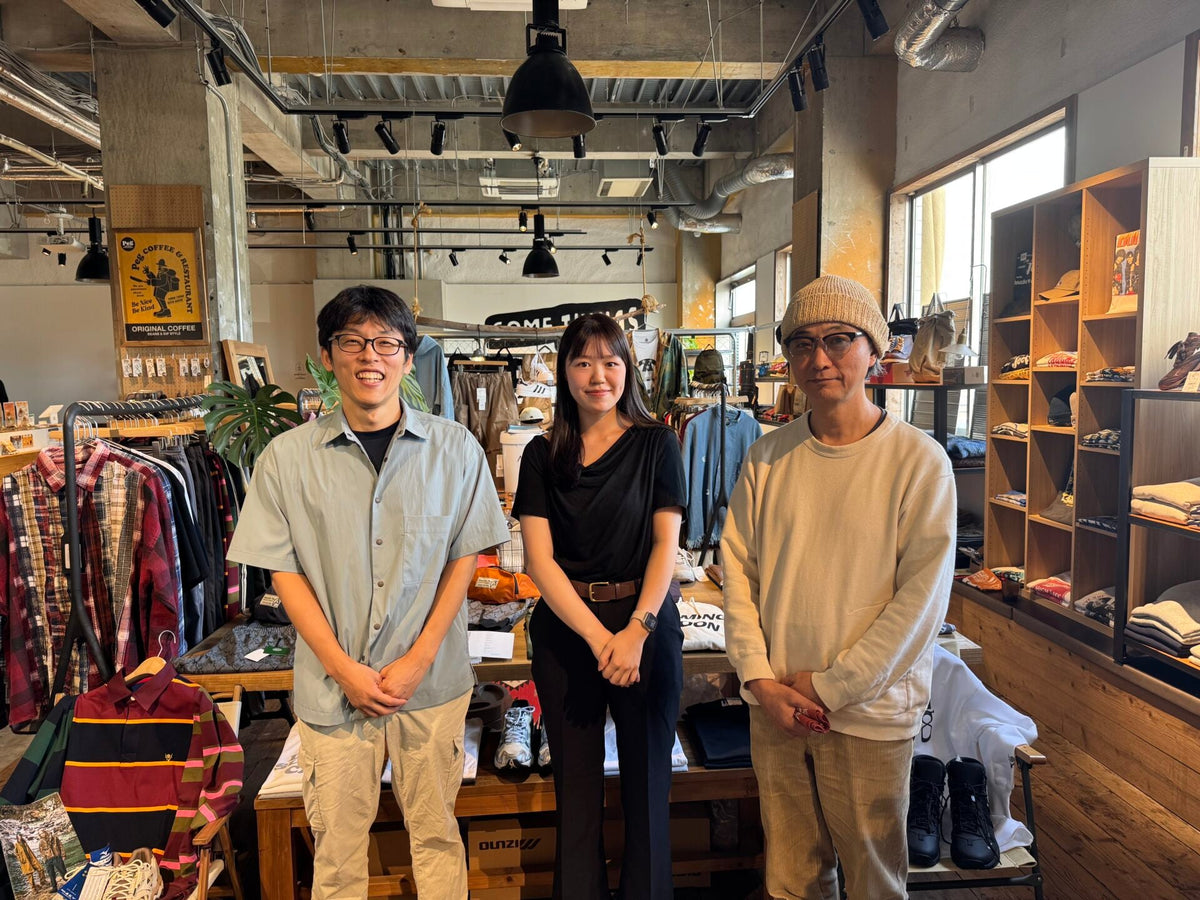
Hero Interview: Overcoming the 'Wall' of Peak Camp and Sauna Boom — NorMo Ayase Garage's Culture-Driven EC Rebranding Strategy for Fashion
Located in Ayase City, Kanagawa Prefecture, "NorMo Ayase Garage" operates a physical store featuring a cafe and a select shop for outdoor and fashion goods. The business rode the wave of the camping and sauna boom during the COVID-19 era and grew steadily — but as the boom peaked out, the company faced a major challenge: declining sales.
In this article, we sat down with Mamemura-san, Tanigawa-san, and Ichikawa-san from NorMo Ayase Garage. We explore the unique initiatives they took to break free from boom dependency and reach new customer segments. Their story holds valuable lessons about "building a team that can adapt to change" — a lesson every e-commerce business should hear.
【Interview Participants】
NorMo Ayase Garage, Division Manager: Seiichi Mamemura
NorMo Ayase Garage, Creative Director & Buyer: Tomonori Tanigawa
NorMo Ayase Garage, EC & SNS Manager: Konomi Ichikawa

The Origin: A Cafe and Rentals. Riding the Boom into Retail — and Then Saunas
Kurose: Thank you for joining us today. To start, could you tell us how NorMo Ayase Garage's business got its start?
Mamemura: Thank you for having us. When we first launched, the two pillars of the business were a burger cafe and rentals — camping gear and custom car rentals. Our management philosophy from the beginning was to put real, hands-on experiences at the core. But, as we ran the numbers, we hit reality hard: about three months in, it became clear that sustaining revenue from just the cafe and rentals alone was going to be very difficult.
Kurose: How did you go from food and rentals to becoming the select shop you are today?
Mamemura: As we were looking for a way to break through that challenge, we started selling physical products. Interest in outdoor activities was growing inside the company at the time, and the camping boom was picking up in Japan as well. With support from manufacturers, we started selling camping gear through pop-up events — that was the turning point.
Kurose: Was the e-commerce site launched at that same time?
Mamemura: Yes. When we started selling products, we built our own website that could handle both rentals and online sales. That was the beginning of our EC journey.
Kurose: Were camping goods the main sellers back then?
Mamemura: They were. After that, we migrated to Shopify as our e-commerce platform — and right around that time, the "sauna boom" hit. We were even hosting outdoor sauna events on our property, and that led us to start carrying a brand called "Sauna Boy." That was the first product to really take off after moving to Shopify. For about a year and a half, that brand drove our sales.

The 'Wall' After the Boom. Pivoting to Fashion — But Struggling to Connect with Existing Fans
Kurose: So you managed to catch the right waves — first camping, then saunas — and grew alongside them.
Mamemura: We did. But after COVID restrictions lifted, the camping boom peaked out. The market stabilized, but it wasn't the same fever pitch as before. As a company, we recognized that the peak had passed.
Kurose: One of your main business drivers had cooled down.
Mamemura: Exactly. So as a company, we made a strategic decision to shift our retail focus from camping gear to fashion-oriented products. We had built our sales on gear, but the new direction was to stay outdoor-rooted while expanding into casual and even vintage clothing — not just high-performance technical wear.
Kurose: That's a major pivot. Did it go smoothly?
Mamemura: It came with a very difficult challenge. When we said we were shifting to "fashion," our existing customers didn't easily follow us.
The vast majority of NorMo Ayase Garage's Instagram followers — currently around 14,000 — followed us during the period when we were sharing content about outdoor activities and sauna culture. When we started pushing fashion items at a completely different price point, those followers weren't ready to come with us.
Kurose: I see. There was a gap between your existing fan base and the new direction you wanted to take.
Mamemura: Precisely. The fashion-interested customers we wanted to reach were genuinely starting from zero. Figuring out how to bridge that gap was our biggest challenge.
The Key to a V-Shaped Recovery: People. Specialized Staff Joining the Team Unlocked Content That Actually Connects
Kurose: How did you go about tackling that major challenge?
Mamemura: The biggest change over the past year or two has been people. About a year after I returned (having stepped away for a time) to take charge of the fashion direction, Ichikawa joined us as our dedicated EC manager.
Kurose: The shift in team structure was significant, then.
Mamemura: Enormously so. Before that, the EC role was often juggled alongside other responsibilities, so there were always things we wanted to do but simply couldn't get to — a backlog of unfinished initiatives. When Ichikawa came on board, she started working through that list, one item at a time. That was a huge first step.
Kurose: Over the past year or two, I've noticed a dramatic increase in outfit content and staff snap photos. Tanigawa-san, you appear as a model too. Personally, as someone who shops at NorMo but isn't a fashion expert, I used to feel uncertain — "how am I supposed to wear this?" But the staff snaps really help. I can picture myself in the look, and that gives me the confidence to buy.
Are there specific approaches you take to how you communicate products? Conveying both functionality and fashion sense seems like it could be tricky.
Tanigawa: Absolutely. We adjust the balance depending on the product. For example, with a brand like "and wander," which combines mountaineering-grade technical performance with a very refined aesthetic, we highlight the fashion angle.
As a buyer, I also think it's important to put into words what I genuinely love most about a product and communicate that to our customers. The buyer review initiative we recently launched has been a great opportunity to rediscover why we chose to stock each item in the first place.

The Advantage of Having a Physical Store. EC and Real-World Retail Converge to Accelerate Brand Discovery
Kurose: Beyond the team changes, what other factors contributed to the sales rebound?
Mamemura: The new brands we've been cultivating for our fashion pivot have finally started appearing on the shop floor. That's been a big part of it.
Fashion brands — especially higher-priced ones — take an enormous amount of time to bring on board. You have to make a pitch, get approval, place an order at a trade show, and wait for delivery. Even in the best case, that's six months. Sometimes it's close to a year.
Kurose: That long?
Mamemura: Yes. So even if we wanted to transform faster, the inventory physically couldn't keep up. Right now, we're at the point where all those brands we worked to bring in are finally arriving on the floor.
Kurose: Does NorMo Ayase Garage have any particular advantage when it comes to bringing in new brands?
Mamemura: Having a physical retail location is a huge one. Many higher-end brands have restrictions around distribution — things like "no online-only sales" or "we only wholesale to brick-and-mortar stores." Because we have a physical store in Ayase, we can meet those requirements. That gives us a significant advantage in running our EC operation.
Kurose: What about O2O (Online-to-Offline) integration between your EC and physical store? For example, member-tier perks like "a free burger at the store" could be a very NorMo Ayase Garage kind of incentive.
Mamemura: Oh, that's a great idea. Who wouldn't want a free burger? (Laughs.) You're right — we could create a flow where online customers come into the store to claim their reward. It's definitely something worth exploring as a strength unique to having a physical location.
Becoming a Team That Can Execute. The Synergy Created Through Partnership with StoreHero
Kurose: We at StoreHero have been working with you for over two years now. Has the team transformation over the past year had any impact on how we work together?
Mamemura: That's actually the key point. I mentioned earlier that the biggest change was in people — and what I feel most strongly is that we've finally become a team that can actually act on the advice we receive from partners like StoreHero. That shift has been immense.
Kurose: In the past, the structure of the team made that difficult.
Mamemura: Honestly, yes. StoreHero had been offering us a lot of great advice for some time, but with our old setup, we simply couldn't follow through on it.
Over the past year, with Ichikawa joining as someone who could actually execute, we finally have the infrastructure to put that guidance to real use. That's something I feel deeply.
Kurose: We've noticed that as the number of initiatives has grown, so has the sales momentum.
Ichikawa: At NorMo, we release new arrivals every Friday, and we send an advance notice on Tuesdays so customers can look forward to it. Being able to keep that routine going consistently has helped customers develop a shopping habit with us. StoreHero has been an incredible partner for even the most challenging implementations — we're truly grateful.
Mamemura: Changes in team structure, changes in the products we'd invested in, and the guidance from our partner — all of these aligned at just the right moment. That's what's finally allowed us to put advice into action, and it's the foundation of the recovery we're seeing today.

The Goal: Becoming a 'Crossroads of Culture.' Building a Community Independent of Booms
Kurose: To close, we'd love to hear about your vision for the future.
Mamemura: Honestly, we're still in a transitional phase. We're working through new challenges every day, asking ourselves how to grow further.
Today's customers are extremely cautious about making purchase mistakes. They compare prices, of course, but they also need the endorsement of someone they trust before they'll buy. In that environment, being chosen as a store isn't just about having the right products on the shelf — it requires a unique identity tied to some kind of "culture," and a genuine conviction behind our curation.
Kurose: Conviction, you say.
Mamemura: Exactly. Some of our staff, for instance, are deeply into cycling and other real hobbies. Using those authentic interests and cultures as a starting point, we want to connect them to our fashion selection in a way that makes compelling sense. The vintage clothing we recently started carrying is part of that same culture-driven approach.
Kurose: So the staff's genuine passions become the business itself.
Mamemura: We want to keep the outdoor foundation while layering new cultures on top of it — building a community that's uniquely NorMo Ayase Garage. Rather than chasing the next boom, we want to create new culture alongside our customers ourselves. That's our challenge going forward.
Kurose: Building a culture and community that belongs uniquely to NorMo Ayase Garage — independent of any boom — is an incredibly exciting challenge to look forward to. Thank you so much for sharing your story with us today.