
Hero Interview: "I Wanted to Improve the Manufacturing Environment" — Driven by a Mission, He Headed to China. Rasical CEO Sanada Shares the Journey of Trial, Error, and Breakthrough Hits from Shopify's Early Days
With the mission of "delivering exciting experiences through products," the D2C brand "Rasical" offers a unique lineup ranging from wallets and bags to high-performance jackets and even office chairs.
Behind it all is the strong conviction of CEO Sanada — "I want to improve the manufacturing environment" — along with the determination he showed by immersing himself in Chinese factories, learning the language, and working hand-in-hand with manufacturers.
Sanada first met StoreHero CEO Kurose in early 2020, when information about Shopify was still scarce in Japan. Starting from the frustration of his first product — a wallet that "just wouldn't sell" — through the explosive hit of masks and the chaos that followed, the success of the high-performance jacket "Fairy Nova," and the massive breakout of "GrowSpica" — a product Kurose had flatly said would never sell — the two have walked this path together for about five years.
We sat down with Sanada to hear about the philosophy behind his meticulously crafted products and the real story of a D2C brand that has overcome countless setbacks.
[Interviewee]
Itaru Sanada, Representative, Rasical Japan LLC

"I Wanted to Improve the Manufacturing Environment" — Product Development in China Born from a Formative Experience
Kurose: I realized I'd never actually heard the full story of how Rasical got started. How did it all begin?
Sanada: Where do I even start? (laughs) Before Rasical, I was running a business making and selling automotive parts. When I sold that business and was thinking about what to do next, I learned that Chinese factories were being forced to work in terrible conditions due to cost-cutting demands from manufacturers. That's when I started thinking, "Can I use a business to improve the manufacturing environment?"
I wanted to create our own products, offer new value to the world, and improve the manufacturing environment. That desire is what led me to start Rasical.

Kurose: Your first product was a wallet, right?
Sanada: Yes, it started with a wallet. It sold reasonably well through crowdfunding, but then came the question of "what next?" From there we started making bags, gradually expanding the lineup.
Kurose: Were you manufacturing in China from the very beginning?
Sanada: Yes. But at the time, I couldn't speak Chinese at all. At first I was working through local intermediaries, and all kinds of problems kept coming up. I thought, "I have to learn the language myself or this will keep being an issue," so I enrolled in a local language school. I started communicating with factories directly while attending school.
"Excitement" Is the Core. Product Development Designed to Avoid Price Competition
Kurose: Every Rasical product feels like it carries your strong personal conviction. Is there a consistent philosophy behind your product development?
Sanada: I never wanted to compete the way large corporations do — mass-producing, cutting costs, and selling cheap. That path inevitably leads to a race to the bottom on price.
Instead, I wanted to make "good things" at "fair prices" — without compromising our values. And I want customers to judge us on value, not price. That value is what we often call the "excitement factor."
Kurose: You do talk about the "excitement factor" a lot.
Sanada: Isn't it surprisingly rare to find something in the world that makes you genuinely think, "I really want this"? Personally, I'm not even that interested in clothes. That's exactly why I want to offer things that have an entertainment quality — something that makes people think, "That's kind of interesting" or "I've never seen anything like that." Things that spark excitement.
Kurose: Rasical definitely has those passionate fans who say they buy everything you release.
Sanada: We do, and we're grateful for them. I think those people genuinely resonate with that "excitement factor." That said, in today's world, even if you create something interesting, it can be imitated almost instantly. If someone told me to build Rasical from scratch again, it would be incredibly difficult.
Shopify's Early Days: The Struggle of "Made It, But It Won't Sell" and Meeting StoreHero
Kurose: You chose Shopify back around 2017 or 2018 — pretty early for Japan. Why Shopify?
Sanada: Being in China, I was exposed to a lot of overseas information. As I was comparing e-commerce platforms, Shopify is what I landed on. I looked at Japanese cart systems too, but the difference in extensibility was night and day.
With apps, you can do this, you can do that. Of course, I was surprised that each app cost money (laughs), but I felt so much potential in the sheer range of possibilities.
Kurose: And then you reached out to me because you were struggling with running the store you'd built.
Sanada: That's right (laughs). It was around the end of 2019 or early 2020. I saw your tweets or blog at the time and thought, "This person seems incredibly knowledgeable."
Kurose: Actually, you were my very first client — you reached out through the contact form on this sketchy-looking website I'd thrown together in two hours, right after I started my company (laughs).
Sanada: Was that right? (laughs) I was really struggling. It wasn't so much that I didn't understand how to use Shopify — the problem was that as a business, I'd "made it, but it wouldn't sell." My previous business had been primarily on Amazon, so I had no experience marketing through my own e-commerce site.
At the time, there were almost no people supporting Shopify operations, so I thought, "This is the only person I can turn to" and reached out.
Taking on the "Impossible" Chair: A Comeback Story Built on Grassroots Sales
Kurose: A lot happened after that. At first the wallets and bags just wouldn't move, then COVID hit and masks sold like crazy.
Sanada: The masks were something else. I learned firsthand that when there's demand, things can sell explosively. But then the supply became unstable and customers were pressuring us to deliver faster. That was really rough.
Kurose: After that, the high-performance jacket "Fairy Nova" became a hit. The response when we ran a survey before launch was incredible — a mix of passionate voices saying "I absolutely have to have this" and harsh comments saying "there's no way they can make it."
Sanada: Yes. The photos were amateur shots I'd taken myself on a ski slope, desperately trying to capture the jacket (laughs). But maybe that enthusiasm and authenticity came through. Polished creative doesn't always sell, but if there's real passion behind it, even amateur photos can. That experience gave me confidence that "you can run crowdfunding-style sales on your own site."

Kurose: The following year's "Fairy Nova 2" also involved collecting customer feedback through a survey before launch — this time bypassing Makuake entirely and running the crowdfunding campaign directly on Shopify, which was another massive hit. Crowdfunding is an incredibly well-suited sales method for Rasical, whose value proposition is centered on that "excitement factor."

Kurose: And then came GrowSpica, the high-performance work chair. Honestly, I thought there was no way a brand known for wallets, bags, and jackets could suddenly pull off a chair. The inventory risk was huge, and the early sales were slow — I was genuinely worried.

Sanada: I believed it would work, though (laughs).
Kurose: But the return on ad spend just wasn't there. So I proposed, "Let's drop the reliance on ads and go all-in on grassroots affiliate outreach."
It might sound odd coming from the person who suggested it, but it's rare to find a brand that pursues affiliate partner development as relentlessly as Rasical did. Building the right systems while still doing the unglamorous, ground-level work — that grit is what drove the results. To this day, the network of affiliates we cultivated during that time continues to be a major pillar of the brand's revenue.
Sanada: That affiliate initiative was huge. Some well-known influencers also happened to pick it up, and things suddenly caught fire.

Kurose: From there, awareness spread — Yodobashi Camera and other major retailers picked it up, and it even appeared in a TV drama. Once something starts selling, ads start working too. That was a real turning point.

Obsessing Over the Desk and "The Challenge of Communicating Value"
Kurose: After the chair became a massive hit, the natural next step was "a desk." Following the success with the chair, I had a feeling this would go smoothly too.
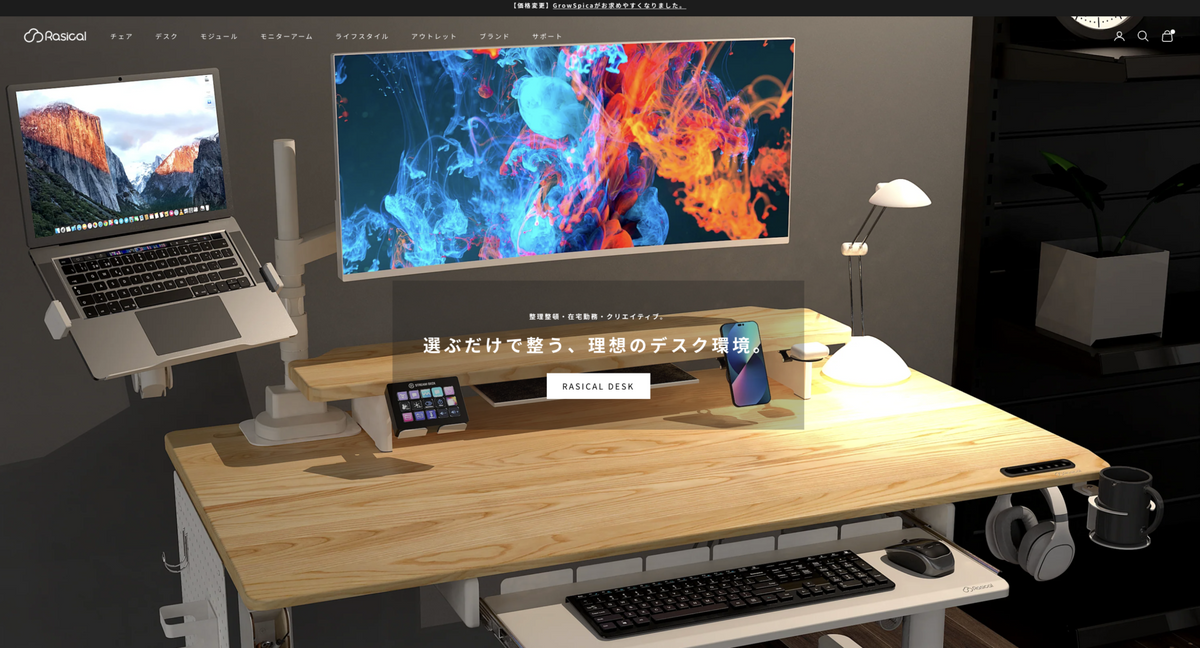
Sanada: Yes. We wanted to apply the know-how we'd built with the chair and create an even more refined product. From the tabletop material to the quality of the legs, everything was meticulously considered — and the design of the Rasical Desk, which lets users freely arrange and customize accessories, required an enormous amount of time and thought.

Kurose: I've heard that the Rasical Desk requires such precise engineering that even a single misaligned hole would make it unusable.
Sanada: Exactly. And when you pour that level of detail into something, the price goes up accordingly. Customers browsing Amazon see budget options at one price point, and what we want to offer sits at a very different level. To bridge that gap, we had to work hard at communicating the appeal of the product.
Anyone who gets to touch it at a trade show immediately says, "This is incredible quality." But in the early days we had no showroom, so we had to focus intensely on conveying the premium quality and precision design online. Like with the chair, we diligently pursued affiliate and influencer campaigns.

Kurose: The steady accumulation of improvements paid off, and sales gradually picked up just like with the chair. The balance between a product's value, the means to communicate it, and its price — that's the eternal challenge of D2C.
Sanada: Absolutely. The "value" we want to deliver and the "price" customers are willing to accept — reconciling those two has been deeply humbling. At the same time, I've gained the confidence that persistent effort can lead to real improvement.
We put a lot of care into content to convey what makes our products special. We use video to explain product specifications in an easy-to-understand way, and we've built out a rich library of use-case content, reviews, and customer interviews.

Thankfully, Rasical's customers and affiliates are always eager to participate in reviews and interviews.

Looking Ahead: Conveying the Brand's Energy Through Content
Kurose: With all that trial and error behind you, what's Rasical's vision going forward?
Sanada: I believe content creation and distribution is critical. Especially now, in the age of video. To get people to truly understand the value and make a purchase, sharing the brand's philosophy and passion through video is indispensable.
We'll double down on that, while continuing to grow our influencer and affiliate partnerships and expand wholesale. I believe there's still a lot of room to grow.
Kurose: Absolutely. The products are compelling — and if we can further strengthen your content output, even more fans will follow. We'll be right there to support you on that front. Thank you so much for your time today.
Sanada: Thank you as well.