
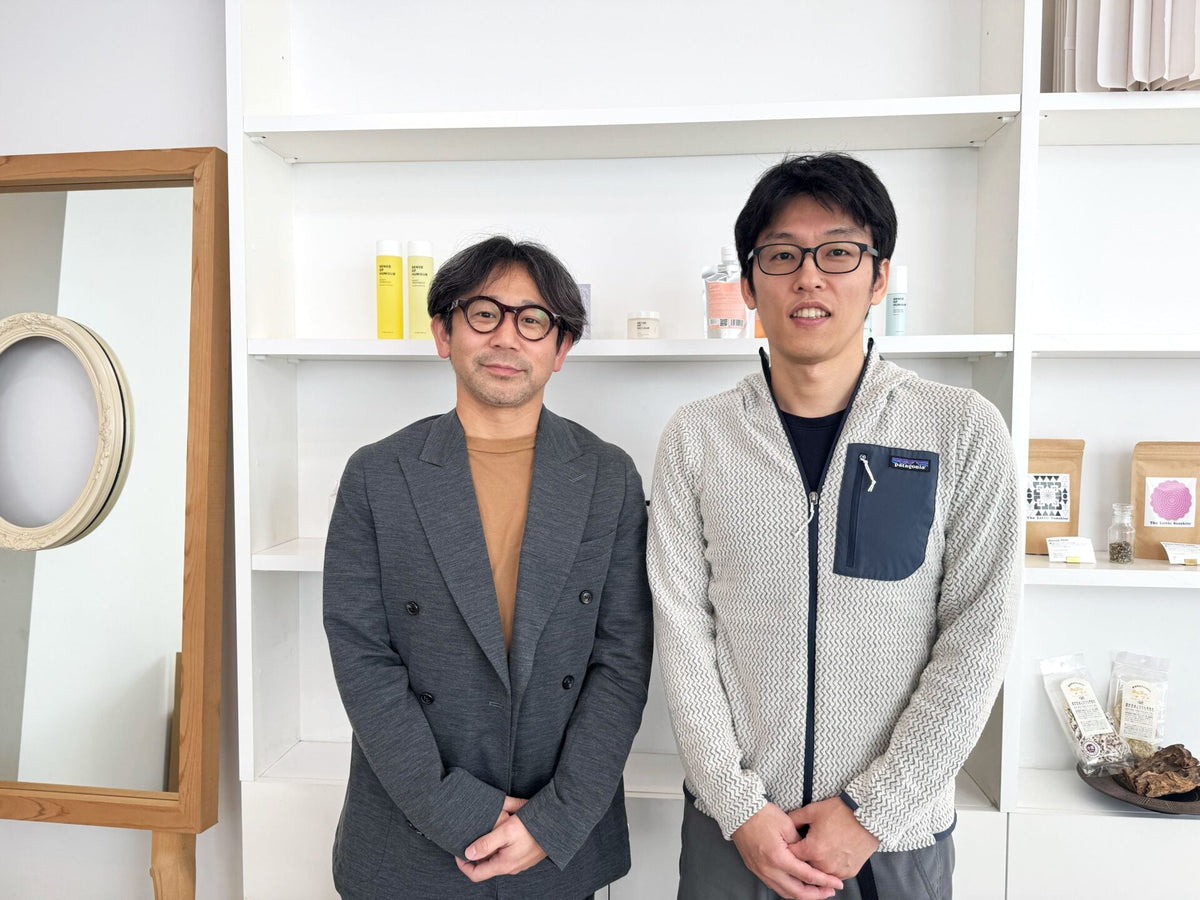
Hero Interview: Rather Than 10 Jobs a Day, a Product That Reaches the World — The Growth Strategy of SENSE OF HUMOR as Envisioned by a World-Class Stylist, and the Challenge of Turning Sensibility into Business
Refined bottle design, and a fragrance and texture that captivates you from the very first use. "SENSE OF HUMOR" is a lifestyle brand founded in 2014 by Kenichi Kajiwara, a top stylist who has been active on the world stage.
Even now, having grown into a brand loved by many fans, the challenge of balancing creation and business — a hurdle faced by many D2C brands — remains at its core. This time, we sat down with founder Kenichi Kajiwara for an in-depth conversation covering the untold story of the brand's founding during his London days, the growing pains of building an e-commerce business on Shopify, the walls he overcame through his partnership with StoreHero, and the brand's next chapter.
【Interviewee】 SENSE OF HUMOR Founder Kenichi Kajiwara

You Only Have One Body: The Formative Experience That Led a Top Stylist to Product Development
──First, could you tell us about the background behind founding SENSE OF HUMOR? You were originally based in London, working as a top stylist, weren't you?
Kajiwara: Yes. I returned to Japan from the UK in 2013 and launched the company in May of the following year, 2014. While in London, I worked in what you might call a "top stylist" position — one of a very small number in the world — doing things like backstage work at fashion shows, magazine shoots, and celebrity hair styling.
But at some point, I had a sudden realization: "I only have one body." Even as I was fortunate enough to receive offers from around the world, if ten jobs came in a single day, I could only accept one. The other nine had to be turned down. No matter how highly regarded I became, as a stylist, there was a physical limit.
──So your own "time" and "body" became the ceiling on your business.
Kajiwara: Exactly. While traveling the world for work, I began thinking about what I could create using my own sensibility — something that could transcend physical limitations and reach people everywhere. And what I arrived at was selling physical products. With a product, even without me being present, it can reach people around the world and bring them joy. That was the biggest driving force behind launching the brand.
──Among all the possible products, why hair care and styling products?
Kajiwara: It started with a sense of discomfort on set. At magazine shoots and similar work, many manufacturers provide products, but honestly, there was almost nothing I could genuinely stand behind and use.
At the time, organic products were becoming the norm overseas, but ten years ago in Japan, the options were still very limited. By looking at the ingredients, you can get a sense of how a product is made, and I simply couldn't find anything in the Japanese market that met my standards in terms of quality. Texture, fragrance, design — I didn't want to compromise on any of it. If it doesn't exist, I'll make it myself — that's where it started.
"Lavender" Can Smell Completely Different: An Obsession with Products That Can't Be Imitated
──SENSE OF HUMOR products have a particularly strong reputation for their "fragrance." What kind of commitment lies behind that?
Kajiwara: Fragrance is one of the areas I'm most particular about, and I believe it's a domain that no other company can truly replicate. For example, even something called "lavender" can smell completely different depending on its origin and extraction method. We source our raw materials one by one from around the world and blend them after confirming each scent with my own nose.
This obsession may stem strongly from my own personal experiences. The excitement of going to a hair salon for the first time in middle school, and the scent of the essential oils I encountered there. Fragrances tied to memories like those move people emotionally beyond any rational explanation. I create scents aiming to appeal to what you might call the sixth sense — fragrances that linger in the memory.
──So the sensibility of an artist is truly embedded in the products.
Kajiwara: That's right. But it's not just about sensibility — I also pursue functionality. For example, our flagship products like the Bohemian Sea Water and Dewy Elixir Oil are 100% plant-based, yet they deliver the styling performance that holds up even in professional environments. There are other gentle, organic products out there, but I believe there are still very few in the world that combine that with a texture that satisfies professionals.

Unrepeatable Sales and Hidden Challenges
──You chose Shopify as your e-commerce platform. What kind of challenges did you face in the early days of running it?
Kajiwara: I chose Shopify because I had a global vision from the very beginning. However, our e-commerce growth came in big waves. In the early days, celebrities introduced us on Instagram and other channels, which helped our sales grow — and for that we were grateful. But that also meant the growth wasn't driven by deliberate strategy.
──That's when your partnership with StoreHero began.
Kajiwara: Yes. When we first reached out to StoreHero, our sales were completely dependent on repeat customers. Nearly 80% of our revenue was being supported by "loyal customers who had purchased five or more times," which looked stable on the surface, but the number of new buyers was actually trending downward. It was a situation of "sales happen when they happen, but there's no repeatability."
We had also entrusted our ad operations to an external agency, but their strategy was unclear and had become a black box. Our CRM was limited to bare minimums like a "salon visit thank-you" email and a cart abandonment email, and we weren't making effective use of our LINE official account either. New customers weren't coming in, and the conversion rate to a second purchase (F2) was declining — I felt a sense of crisis about the brand's sustainable growth.
──And from there, you began working together with us toward growth.
Kajiwara: First came thorough "defensive" groundwork. At that time, we were letting customers who came to us slip right through our fingers. Specifically, we implemented automated email sequences using a CRM tool (welcome emails, reminders, subscription continuation, etc.), automated LINE messaging, and pop-ups to capture leads when visitors were about to leave. We also planned and built a quiz page so customers could find the right products for themselves.
──That was the phase of building a solid CRM foundation.
Kajiwara: Exactly. This started generating revenue through CRM, and we first established the infrastructure to properly care for existing customers. However, that alone wasn't enough to drive explosive growth in new customer sales.
──So then you moved to the next "offensive" phase: new customer acquisition and product strategy.
Kajiwara: Yes. At that point, we clearly identified our "focus products." We centered everything around the Dewy Elixir Oil and Bohemian Sea Water, and also expanded our lineup of bundled product sets.
In line with this, we restructured our ad operations. For Meta ads, we leveraged ASC (Advantage+ Shopping Campaigns) and actively introduced UGC and vertical video content. Together with StoreHero, we continuously tested "winning messages" tailored to our focus products and customer needs, while also optimizing our ad landing pages.
──So CRM, advertising, and product strategy all started working in sync.
Kajiwara: Exactly. For new customers, we use ads to spark interest, use the landing page to communicate the brand's appeal, and then follow up with cart abandonment or product browsing reminder emails if they're about to leave. After purchase, we built an automated system of step emails to encourage F2 conversion — including upsell scenarios from single items to subscription plans, and recommendations for the full-size product to sample purchasers.

A Virtuous Cycle: New Customers Growing, Repeat Customers Thriving
──After all these initiatives, what kind of changes and results have you seen?
Kajiwara: We've clearly become able to "acquire new customers," and with that, a virtuous cycle has emerged where the total number of repeat customers also grows. The barrier to subscribing was previously quite high, but now we're seeing more people repeat single purchases first, and then naturally settling into a subscription from there.
Looking at the numbers, the proportion of customers acquired after we implemented these initiatives who continue to make a third, fourth purchase is showing improvement. The simple fact is that more new customers means a larger overall customer base — but what I feel is the greatest achievement is that we've built this as a repeatable system, not a one-off boom like we had before.
Living the "Jetset" Life: The New Luxury Proposed by SENSE OF HUMOR
──I'd also like to ask again about the brand concept. What kind of meaning is embedded in keywords like "Bohemian" and "Gypset"?
Kajiwara: "Gypset" is a coined term combining the free-spirited "Gypsy" with the globe-trotting "Jet Setter." It refers to a lifestyle that is intensely driven in work, yet spiritually free — bound by nothing. That's the kind of modern lifestyle we want to propose.
──And is that the kind of values your target customers hold?
Kajiwara: Yes. In simple terms, it's not the flashy, ostentatious kind of luxury — it's people seeking an intellectual richness, like living quietly by the sea. They appear simple and natural on the surface, but they actually know the most luxurious way to spend their time. I feel that SENSE OF HUMOR products are embraced by that kind of quietly elegant customer. That's precisely why, in product development, we don't focus on obvious opulence, but rather on fundamental quality and fragrances that resonate with the heartstrings.

Expanding from Fragrance into All Aspects of Lifestyle: SENSE OF HUMOR's Next Challenge
──Finally, could you tell us about your future vision?
Kajiwara: First is expanding our product lineup. Currently, our focus is on hair care, but going forward we want to broaden our scope to cover all aspects of lifestyle, with fragrance at the core. For example, we're currently developing products like fabric sprays — items that can be used safely in homes with pets or babies, combining deodorizing and antibacterial properties with beautiful scent. We're aiming for a world where SENSE OF HUMOR products are present in every scene of daily life — from stepping out of the bathroom, to commuting, to the office, to the bedroom.
Second is a physical "head spa" business. We are planning to open a head spa salon in Omotesando in 2026. This will be a place where visitors can experience the brand's world more deeply. At the same time, this is also a response to a challenge facing the beauty industry. Many licensed hairdressers have left the profession due to grueling working conditions and other factors — I want to create a place where these dormant beauty professionals can shine again through the art of head spa. By creating education and employment opportunities, I hope to give something back to the industry.
──So both deepening and expanding the brand. We look forward to seeing what comes next.
Kajiwara: SENSE OF HUMOR will continue to pursue its vision without compromise, as a place to express my sensibility. While turning both the wheels of sensibility and business, I want to keep proposing new value going forward.