
Essential Knowledge for Achieving Growth on Shopify: What Is a Growth Workflow?
At StoreHero, we use a methodology called the Growth Workflow to support the continuous growth of Shopify merchants' commerce businesses. In this article, we'll provide an overview of how to approach growth initiatives using the Growth Workflow.
By reading this article, you'll gain a clear picture of how to drive growth initiatives from start to finish.
Download the Store Design Guide for High-Converting Stores (Free)
StoreHero leverages its proprietary growth platform to support business growth through granular operations that are impossible to achieve manually, as well as the large-scale execution of growth initiatives. If you're struggling to increase sales on Shopify, feel free to reach out.
=>Click here to download our service introduction materials for free
What Is a Growth Workflow?
At StoreHero, we refer to the systems and operational rules that generate continuous growth as a "Growth Workflow."
Continuous growth requires reproducibility. Rather than aiming for one lucky grand-slam initiative, the goal is to consistently deliver hits — regardless of whether they're home runs or singles.
Three Key Points for Building a Growth Workflow
The following three points are essential when building a Growth Workflow.
- Systematization
- Range of tactics
- Measurability
Systematization is critical for delivering consistent results. Common commerce challenges — such as "acquiring new customers," "increasing purchase frequency among existing customers," or "spiking sales for a new product" — each have proven "playbooks" for solving them. The key is to adapt these playbooks to your own business and build them into a system.
Systems should incorporate a degree of flexibility. It's impossible to create a manual at the outset that guarantees 100% success if followed exactly. Instead, you improve the system to better fit your business as you operate it. By defining the range of tactical options upfront, teams can make faster decisions in the field.
Without measurement, you can't determine whether improvements are needed. You need to be able to measure how well your Growth Workflow is performing by combining data from Shopify, Google Analytics, and other sources.
The 5 Steps to Leveraging a Growth Workflow
Leveraging a Growth Workflow involves five steps.
- Issue Identification
- Growth Model Design
- KPI Design
- Growth Workflow Design
- Growth Workflow Operation & Improvement
We'll cover each step in detail in future articles. For now, here's a brief overview of each.
Issue Identification
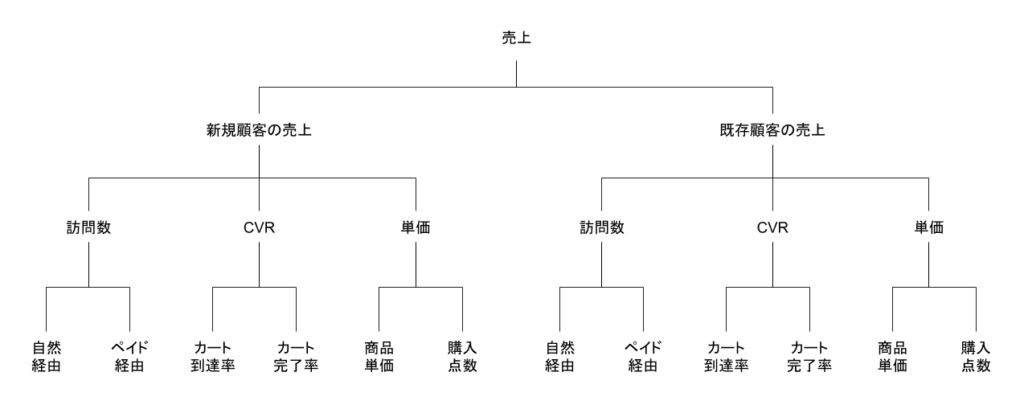
Growth issues are identified by looking at the gap between targets and actual results. A KPI tree is a useful tool for this. The diagram below shows a KPI tree with revenue at the top.

Issues are identified by breaking down the top-level metrics in the KPI tree.
For example, issues might be broken down as follows:
- Overall revenue is 20% below target.
- New customer revenue is 40% below target, while existing customer revenue is not significantly below target.
- Of the shortfall in new customer revenue, paid advertising accounts for 20% and CRM channels account for 10% of the gap.
Growth Model Design
Once issues are identified, you design a growth model on Shopify to address them. The growth model is organized into four phases: audience building, traffic acquisition, purchase conversion, and repeat purchase promotion.

The goal of audience building is to generate prospective customers. This includes initiatives such as gaining engagement on social media and increasing media coverage. KPIs here include email/LINE subscriber counts, branded search volume, and ad impression metrics.
Next, you drive those prospects to your store. This includes targeted advertising aimed at prospects, as well as purchase-driving initiatives directed at social media followers and email/LINE subscribers.
You then guide those visitors toward their first purchase. Since the first purchase presents the highest barrier, various approaches are needed — such as creating dedicated landing pages for ads, offering entry-level hook products, and running first-purchase-only promotions.
Finally, you use email, LINE, and apps to encourage first-time buyers to make repeat purchases, aiming to increase LTV (Customer Lifetime Value).
A growth model is the combination of these four phases — audience building, traffic acquisition, purchase conversion, and repeat purchase promotion — assembled in a way that suits your brand.
Key Points in Growth Model Design
Initiatives included in the growth model have both positive and negative effects, so it's important to design the model while accounting for the downsides, not just the benefits.
As an example, consider designing initiatives to improve email-driven revenue from ¥630,000 to ¥1,000,000 as a smaller purchase-conversion challenge.

At first glance, simply increasing email send frequency seems like the obvious solution. However, while increasing frequency may temporarily boost email-driven revenue, it also raises the likelihood that emails will go unread, making it difficult to sustain ¥1,000,000 over the long term.
Instead, you should refine email segmentation, tailor content accordingly, maintain subscriber engagement, and combine this with email sign-up campaigns to grow your subscriber base — so that email-driven revenue sustainably reaches ¥1,000,000.
As this example illustrates, most initiatives carry both positive and negative effects. The key to growth model design is combining multiple initiatives so that their positive effects outweigh the negative ones.
KPI Design
Each initiative included in the growth model should have its own KPIs. KPIs break down the goals assigned to each initiative into actionable metrics.
For example, continuing with the email initiative, rather than tracking only overall email-driven revenue, try designing KPIs that separate email subscribers into non-purchasers and existing customers. This makes it immediately visible which group has a shortfall and by how much, making it easier to determine the right course of action.

Behind every KPI lie various assumptions and preconditions. Making these visible helps the team develop a shared understanding.
For example, each KPI in the target sheet above has underlying assumptions and preconditions. These may not be apparent at first glance, but once visualized, the thinking behind the targets and KPIs becomes much easier to understand.

Growth Workflow Design
Once you have a growth model linked to your business plan and KPIs, the next step is to translate it into operational systems and rules — the Growth Workflow.
When it comes to systems for Shopify, it's important to think of it as designing and implementing Shopify and its surrounding ecosystem to fit your growth model.
Shopify's native features, themes, and apps alone allow you to implement sophisticated systems quickly. It also offers strong integrations with external platforms such as Google, Meta, TikTok, and Pinterest, and connecting with inventory and logistics via OMS/WMS (Order/Warehouse Management Systems) has become much easier. You can also link Shopify, its apps, and peripheral services together using tools like Shopify Flow, Zapier, and Parabola.
To maximize the benefits of the ecosystem, build your systems while avoiding over-customization and maintaining integration compatibility.
When translating your systems into a Growth Workflow, two key points are: allowing a certain range of tactical flexibility, and enabling best practices to be followed naturally.
Below is an example sheet for organizing an email operations policy.

Allow a Range of Tactical Flexibility
Business plans and KPIs are often designed based on historical data. While past data is useful for planning, reality differs from projections — so to hit your targets, you need to adjust your systems and operations within a defined range as you go.
Even if you plan for ¥1,000,000 in revenue from a single email send, shifts in product trends or competitor activity may cause you to fall short. In such cases, it helps to define in advance what tactical options are available for field-level decision making, so teams can respond flexibly.
The "optional initiatives" column on the far right of the email operations policy sheet above corresponds to this range of adjustment options.
Enable Best Practices Naturally
It's equally important to ensure that obvious best practices are executed consistently.
For instance, most people would agree that understanding which products are being purchased through which channels and by whom is essential for making tactical decisions.
However, day-to-day operations are busy and wide-ranging, leaving little time to check what's selling through which channels. Data and information needed for such decisions should be systematized so they can be reviewed naturally in the course of everyday work. Processes that don't require human judgment can also be automated.
Additionally, when selling online, platform algorithm changes on services like Instagram and Amazon directly affect sales — but it's difficult for everyone on the team to stay on top of these developments. That's why it's important to create systems and operational rules that enable every team member to naturally follow best practices.
Growth Workflow Operation & Improvement
Once the Growth Workflow is designed, each team member operates it within their respective area. During operations, monitor the gap between targets and actual results, identify issues using granular field-level metrics, and implement improvement actions.
At StoreHero, we use our Shopify-dedicated growth platform, StoreHero, to consolidate target-vs-actual monitoring, discussion of improvement actions, and task management in one place.

High-precision tactical insights emerge when you dive deeper into the data. Below is an example of email-driven revenue trends broken down by age group (data is fictional). Revenue regularly spikes among customers in their 30s, but recently, sales among those in their 40s and 50s have also been growing. Meanwhile, sales among those in their 20s haven't increased much. This suggests that recent messaging may not be resonating with younger audiences. A reasonable approach would be to continue the current messaging for the 30+ demographic while testing different messaging for the 20s segment.

As mentioned earlier, pre-defining the direction of improvement actions for each metric speeds up initiative execution. By also making the data that informs those actions readily accessible at any time, you can improve not just speed but also the precision of your initiatives.
Evolving Your Growth Model and Growth Workflow
As your business grows, your challenges change — and your growth model and Growth Workflow need to evolve accordingly. When making changes, the key is to redesign in a way that preserves what was working well before.
For example, consider a scenario where you initially focused on traffic acquisition, running a Growth Workflow centered on initiatives to drive more visitors. Later, the main challenge shifts to repeat purchasing, and you restructure the workflow around repeat purchase promotion initiatives.
If the total time available for growth initiatives stays the same, dedicating more time to repeat purchase promotion means less time for traffic acquisition.
However, if you've built strong equity with platforms like Google and Instagram, paid ads tend to perform better, making it easier to supplement some organic traffic with paid. And if your Instagram presence was activated through traffic acquisition initiatives, you can leverage UGC (User-Generated Content) in your CRM to amplify the impact of your repeat purchase promotion efforts.
In this way, when restructuring your Growth Workflow, it's important to efficiently leverage the assets built under the previous workflow in the new one. When redesigned well, this can accelerate your business to an even higher level of growth.
Thorough Growth Execution with StoreHero
StoreHero supports Shopify merchants who want to increase sales with thorough execution of growth initiatives.
Leveraging the StoreHero growth platform, we help merchants achieve continuous growth through granular operations across advertising, store management, CRM, and inventory — operations that are difficult to achieve manually — as well as large-scale initiative execution.
We currently offer a free store diagnostic. If you have challenges related to Shopify and growth initiatives, please don't hesitate to reach out. Click here for details on the free store diagnostic
Summary
In this article, we covered the basics of the Growth Workflow concept that StoreHero uses when supporting Shopify merchants. We hope you now have a clear overall picture of how to approach growth initiatives using the Growth Workflow.
In future articles, we'll explain how to operate based on the Growth Workflow concept, broken down by stage of business growth.
StoreHero can support you from the very foundation of building a high-converting store. Feel free to reach out anytime. =>View StoreHero's Service Introduction Materials